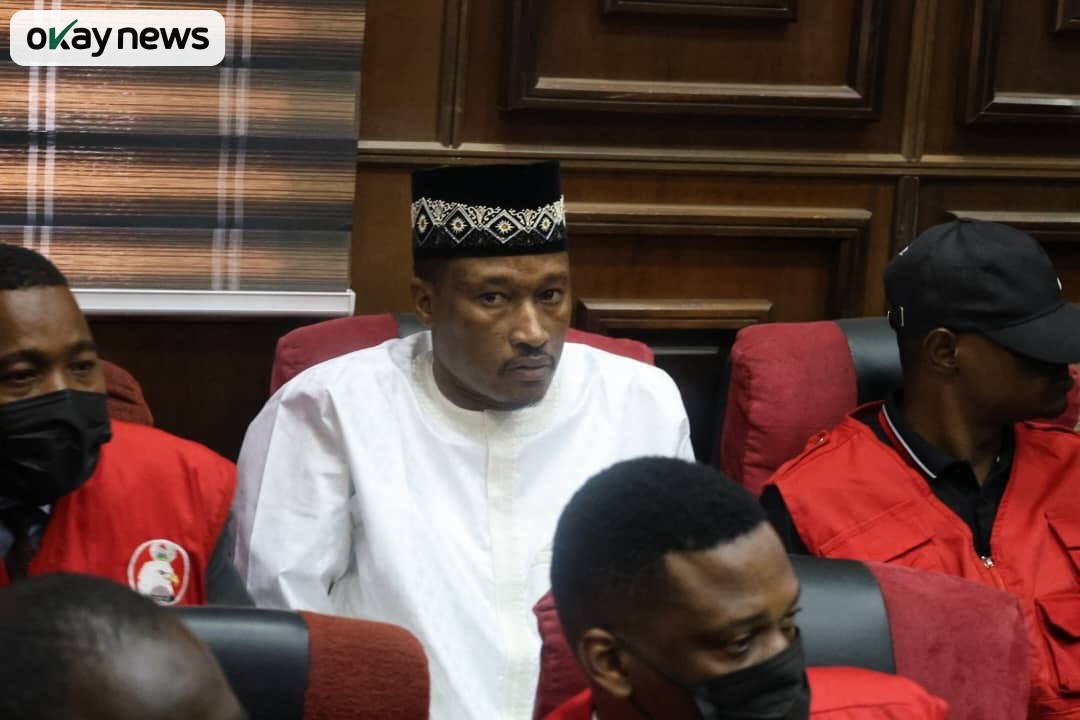
Justice Emeka Nwite of the Federal High Court, one of Nigeria’s superior courts with jurisdiction over federal offences, on Tuesday returned the terrorism financing and money laundering case involving the Bauchi State Commissioner for Finance, Yakubu Adamu, to the Chief Judge of the court for reassignment following the court’s resumption from its annual vacation.
The decision was taken during proceedings at the Federal High Court sitting in Abuja, Nigeria’s capital city and seat of the federal government, after the matter was called and no legal representative appeared for the prosecution.
Okay News reports that Adamu, who currently serves as the Commissioner for Finance in Bauchi State, located in northeastern Nigeria, is standing trial alongside three other senior civil servants of the Bauchi State Government over allegations of terrorism financing and money laundering brought against them by the Economic and Financial Crimes Commission, Nigeria’s anti-graft and financial crimes enforcement agency.
The defendants were arraigned before the court on Tuesday, December 31, 2025, on a 10-count charge and each pleaded not guilty to all allegations.
On Monday, January 5, 2026, Justice Nwite rejected their separate bail applications, holding that the alleged offences posed a serious threat to Nigeria’s national security and public safety. The judge consequently ordered that the defendants be remanded at the Kuje Correctional Centre, a maximum-security custodial facility located in Abuja.
The court had fixed Tuesday, January 13, 2026, for the formal commencement of trial and further directed that the matter be given accelerated hearing due to the gravity of the charges.
However, when the case was called on the scheduled date, no lawyer appeared on behalf of the Economic and Financial Crimes Commission to prosecute the matter.
Counsel to the defendants, Chris Uche, Senior Advocate of Nigeria, informed the court that during the January 5 proceedings, the judge had indicated that the case was adjourned to Tuesday because the court was sitting as a vacation court at the time.
“In obedience to the fixing of the case for today, the defendants have been produced from Kuje Prison and we, their lawyers, are also here for today’s proceedings,” Uche told the court.
He further explained that he had encountered Adebayo Ojo, Senior Advocate of Nigeria, in another courtroom, who informed him that he had recently been briefed as the new prosecuting counsel for the Economic and Financial Crimes Commission and that his junior colleagues would appear for the case.
When Justice Nwite asked whether any of Ojo’s junior lawyers were present in court, there was no response.
Taking into account that the matter was initiated and handled during the court’s vacation period, the judge ordered that the case file be returned to the court registry for reassignment by the Chief Judge of the Federal High Court.
Yakubu Adamu, a former branch manager of Polaris Bank in Bauchi State, is listed as the first defendant in the charge. The remaining defendants are Balarabe Abdullahi Ilelah, Aminu Mohammed Bose, and Kabiru Yahaya Mohammed, who are named as the second, third, and fourth defendants respectively.
The charge, marked FHC/ABJ/CR/705/2025, was filed on Monday, December 30, 2025, by counsel to the Economic and Financial Crimes Commission, Samuel Chime.
According to the prosecution, the first count alleges that Adamu, alongside the Bauchi State Accountant-General, Sirajo Jaja, and Samaila Irmiya Liman, both of whom are currently at large, conspired with Ilelah, Bose, and Mohammed between January and May 2024 to provide funds amounting to $2.3 million in cash.
The funds were allegedly provided for the benefit of Bello Bodejo and individuals associated with him, purportedly following approvals granted by the Governor of Bauchi State, Bala Mohammed, who is the elected chief executive of the state.
The Economic and Financial Crimes Commission alleged that the funds were used wholly or partly to finance a terrorist or terrorist organisation operating within Nigeria.
The alleged offence is said to be contrary to Section 26, Subsection 1, and punishable under Section 21, Subsection 2, Paragraph A of the Terrorism (Prevention and Prohibition) Act, 2022.