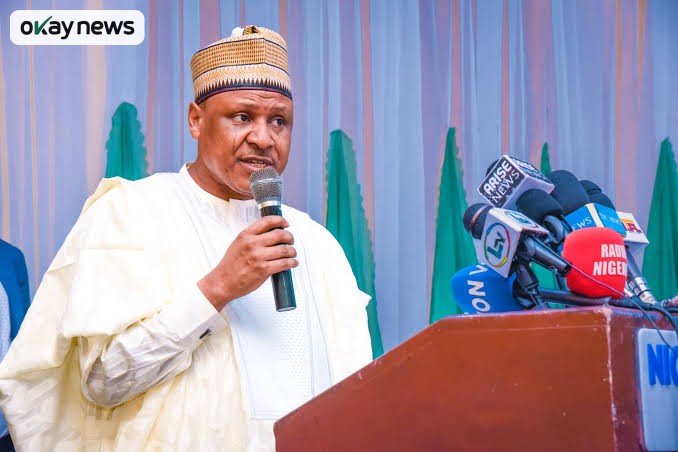
Nigeria’s Minister of Information and National Orientation, Alhaji Mohammed Idris, has said the economic changes introduced by President Bola Ahmed Tinubu, Nigeria’s leader since May 2023, are beginning to stabilise the country’s economy and rebuild confidence among investors and international partners.
Idris made the remarks during a virtual interview on ICAN On Air, a live programme run by the Institute of Chartered Accountants of Nigeria (ICAN), one of Nigeria’s leading professional accounting bodies. Okay News reports that his comments were later shared in a statement released on Friday, 6 February 2026, in Abuja, Nigeria’s capital, by his Special Assistant on Media, Malam Rabiu Ibrahim.
The minister said the decision to remove Nigeria’s long-running fuel subsidy and unify the foreign exchange rate were taken early in the administration because the government believed the economy had deep structural problems that could no longer be ignored.
He argued that the previous model was not sustainable, saying the country could not continue with a system where the basics were weak. “You cannot build an economy where the foundation itself is extremely faulty,” he said.
Idris pointed to the situation around May 2023, saying about 26 of Nigeria’s 36 states were struggling to pay salaries at the time, while roughly 97 percent of government revenue was being used for debt servicing. He said that path threatened the country’s economic survival.
He acknowledged that the reforms created immediate hardship for many Nigerians but insisted the steps were meant to correct long-standing distortions and ensure national resources were used in a way that benefits more people across the country.
“These were not politically convenient decisions,” Idris said, adding that the President believed urgent action was required to prevent deeper economic damage.
The minister said recent indicators suggest improvement, including stronger foreign reserves, easing inflation, and rising confidence from investors and international partners. He claimed Nigeria’s foreign reserves are now about $46 billion, which he described as the highest level in about eight years.
He also said Nigeria’s removal from the Financial Action Task Force (FATF) grey list has boosted the country’s credibility. The Financial Action Task Force (FATF) is a global intergovernmental body that sets standards for fighting money laundering and terrorism financing, and its grey list flags jurisdictions that are under increased monitoring.
On tax reforms, Idris said the goal is not to increase the burden on citizens but to simplify the tax system, reduce duplication, and bring more people and businesses into the tax net so government planning and development can improve.
“The tax reform is not meant to make people pay more tax,” he said. “It is to simplify the process, remove duplication, and bring those outside the tax net into it, so the government can plan better for development.”
Idris stressed that trust is central to governance and public communication, saying honest engagement is necessary to build confidence and support long-term growth.
“Without trust, there is no way you can build confidence, and without confidence, there can be no meaningful development,” he said.
He added that President Tinubu regularly asks for feedback on policies and may adjust implementation when needed, while still maintaining reforms the government considers essential for long-term progress.
Addressing misinformation, Idris said the government is strengthening cooperation among agencies and improving media literacy to limit the spread of false information without restricting free speech.
“Fake news is dangerous,” he said, while adding that media freedom must come with responsibility.
He also said Nigeria has secured the bid to host the United Nations Educational, Scientific and Cultural Organization (UNESCO) first Category-2 Media and Information Literacy Institute. UNESCO is a United Nations agency that supports education, science, culture and communication worldwide, and Category-2 institutes typically operate under UNESCO’s auspices to build skills and capacity.
Idris urged Nigerians to remain patient and involved as the reforms continue, expressing confidence that gains will become clearer over time in areas such as infrastructure, education, healthcare and development at state and local levels.