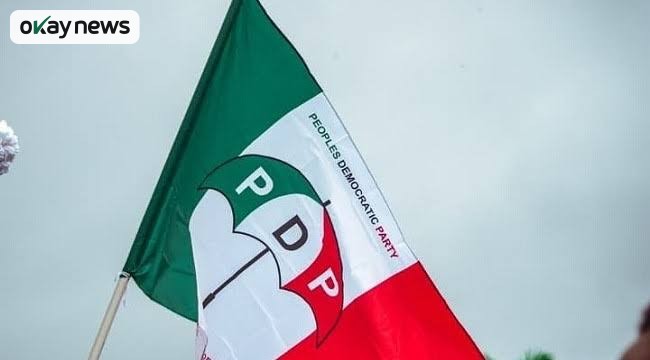
Senior stakeholders of Nigeria’s main opposition party, the Peoples Democratic Party, have outlined extensive conditions for reconciliation as efforts intensify to resolve the party’s prolonged internal leadership crisis, a development that has continued to weaken its political standing ahead of Nigeria’s 2027 general elections.
The crisis, which has split the party’s National Working Committee into rival factions, has sparked debates around party structure, the legitimacy of conventions, the need for public apologies, and the possibility of resetting leadership arrangements through constitutional processes.
Okay News reports that members aligned with both the faction led by Tanimu Turaki, a Senior Advocate of Nigeria and former Minister of Special Duties, and the group loyal to Abdulrahman Mohammed, who claims acting leadership status, confirmed that reconciliation talks were ongoing but remained at an early and exploratory stage.
According to sources who requested anonymity due to the sensitivity of the negotiations, options being considered include convening a National Executive Committee meeting or organizing another national convention to address unresolved leadership disputes.
Governors elected on the platform of the Peoples Democratic Party had earlier endorsed the Ibadan convention held on Saturday, Sixteenth November Two Thousand and Twenty-Five, where Turaki and other members of the National Working Committee were elected for a four-year term.
However, Nigeria’s Minister of the Federal Capital Territory, Nyesom Wike, a former Governor of Rivers State and a key party powerbroker, alongside his allies Abdulrahman Mohammed and Senator Samuel Anyanwu, a former National Secretary of the party, have continued to insist that they remain the acting National Chairman and acting National Secretary respectively.
Despite efforts by governors to ensure a smooth transition from former National Chairman Umar Damagum ahead of the formal expiration of his tenure on Tuesday, Ninth December Two Thousand and Twenty-Five, the Wike-aligned faction moved a day earlier, on Monday, Eighth December, to constitute a thirteen-member caretaker committee with a sixty-day mandate.
Since that action, both factions have intensified lobbying efforts seeking official recognition from the Independent National Electoral Commission, Nigeria’s constitutionally empowered electoral management body.
As a result of the unresolved leadership dispute, the electoral commission has declined to recognize any candidate presented by the Peoples Democratic Party for the forthcoming governorship election in Ekiti State, located in southwestern Nigeria.
Beyond the immediate electoral setback, the party has continued to lose political relevance as several members defect to Nigeria’s ruling party, the All Progressives Congress, while others have joined smaller opposition platforms such as the African Democratic Congress.
A party insider disclosed that stakeholders now largely agree that resorting to prolonged court battles could further damage the party’s prospects and weaken its ability to compete effectively in future elections.
He said, “With the recent position taken by the Independent National Electoral Commission and its meetings with both factions, it has become increasingly clear that party leaders need to shift ground and find a way to resolve the crisis. Contrary to reports that some names have already been shortlisted for a caretaker committee, that is not true. Discussions are still at a very early stage, with members and stakeholders engaging on possible solutions and exploring all available options.”
He added that litigation across multiple courts, including the Federal High Court, the Court of Appeal, and potentially the Supreme Court of Nigeria, could drag on well into the period when political parties would ordinarily be concluding their primary elections for the Two Thousand and Twenty-Seven polls.
Another source explained that reconciliation discussions include proposals for public and private apologies, lifting of suspensions and expulsions, a possible dissolution of existing leadership structures, and the establishment of a caretaker committee jointly nominated by both factions under the supervision of the electoral commission.
Further confirmation came from another stakeholder, who said that alternative dispute resolution, rather than courtroom confrontation, had become the preferred path.
He said, “We have been reaching out, calling and talking to one another, visiting and exploring possible solutions through alternative dispute resolution. However, to achieve this, certain conditions must be met.”
Former Senate President Bukola Saraki, who served as Nigeria’s third-highest-ranking political office holder from Two Thousand and Fifteen to Two Thousand and Nineteen, is also reportedly leading behind-the-scenes reconciliation efforts alongside lawmakers from both chambers of Nigeria’s National Assembly and senior party elders.
When contacted, the National Publicity Secretary of the Turaki-led National Working Committee, Ini Ememobong, confirmed that discussions were ongoing, stressing that reconciliation was essential for the survival of the party.
On his part, Okechukwu Osuoha, a member of the Wike-backed caretaker committee, said dialogue remained the only viable solution and warned that ignoring court rulings had worsened the party’s instability.
Political analyst and President of the Nigerian Political Science Association, Professor Hassan Saliu, also emphasized that reconciliation, compromise, and sacrifice were critical for restoring unity within the party.
He said, “Litigation is time-consuming and could affect the party’s ability to field candidates. Reconciliation through dialogue, compromise and sacrifice remains the best option.”