More than two months after Nigeria’s House of Representatives, the lower chamber of the National Assembly of the Federal Republic of Nigeria, resolved to investigate the utilisation of football development grants allocated to the Nigerian Football Federation, the House Committee on Sports has yet to submit its findings, raising concerns among lawmakers and the public.
The Nigerian Football Federation, which is the officially recognised governing body responsible for football administration in Nigeria, allegedly received over $25,000,000 in development grants between 2015 and 2025 from the Fédération Internationale de Football Association, the global governing body for football headquartered in Zurich, Switzerland, and the Confederation of African Football, Africa’s continental football authority based in Cairo, Egypt.
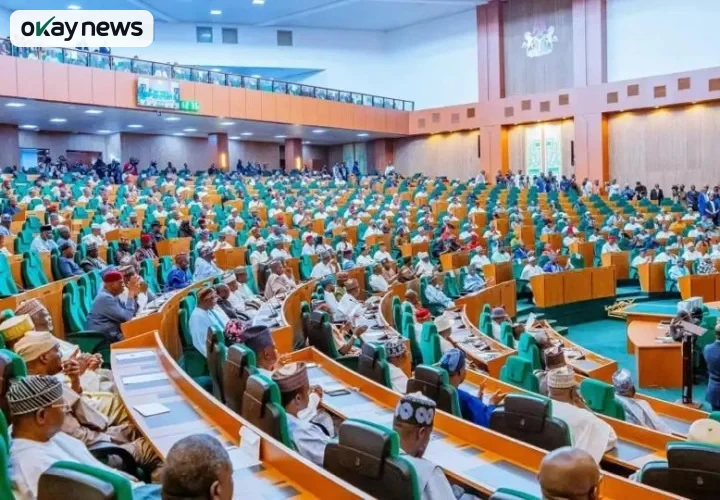
Okay News reports that the House of Representatives adopted a motion of urgent public importance in October 2025, mandating an investigation into the management of these funds following persistent allegations of misappropriation and weak accountability within Nigeria’s football administration system.
The motion was co-sponsored by Adedayo Adesola, a member of the House of Representatives representing Apapa Federal Constituency in Lagos State, Nigeria’s commercial capital, and Felix Nwaeke, who represents a federal constituency in Rivers State, located in southern Nigeria’s oil-producing Niger Delta region.
Titled “Motion To Stop Further Misuse Of FIFA And CAF Grants By Nigerian Football Federation,” Adesola argued during plenary proceedings that the alleged financial mismanagement had directly contributed to the declining performance of Nigeria’s national football teams across international competitions.
The concerns gained further traction following previous allegations made by Sunday Oliseh, a former captain of Nigeria’s senior men’s national football team, the Super Eagles, who accused the Nigerian Football Federation of undermining football development through the mismanagement of international grants. Oliseh specifically cited the handling of a $1,000,000 grant released by FIFA to prepare Nigeria for the 2002 Fédération Internationale de Football Association World Cup.
Between 2015 and 2025, the Nigerian Football Federation reportedly received development funding exceeding $25,000,000 from FIFA and the Confederation of African Football. Critics argue that there is little visible infrastructure, youth development, or technical advancement to justify the scale of these funds.
On Tuesday, October 28, 2025, instead of setting up a special investigative committee as requested in the motion, the House of Representatives resolved to refer the matter to its standing Committee on Sports, mandating the panel to review the allegations and submit recommendations for further legislative action within four weeks.
However, the committee failed to meet the deadline before the National Assembly adjourned for the Christmas and New Year legislative recess in December 2025, prompting renewed criticism from lawmakers.
Speaking on Thursday, January 15, 2026, Adedayo Adesola, who is also a member of Nigeria’s ruling All Progressives Congress political party, expressed frustration over the delay.
He said, “Nigerians are interested in knowing the outcome of the committee’s findings. It is over two months now since the Committee on Sports was given the assignment. So, where are we? What are the findings?”
Adesola further linked Nigeria’s failure to qualify for the 2026 FIFA World Cup, which will be jointly hosted by the United States of America, Canada, and Mexico, to administrative lapses rather than technical shortcomings.
He said, “Nigerians are addicted to football. It is a game that knows no tribe or religion. However, the management of football in our beloved country has left much to be desired in recent years.”
“We are missing the World Cup this year for reasons that are largely administrative. It is difficult to highlight what we have missed given our inability to qualify for the tournament.”
“The leadership of the committee should let Nigerians know the details of its findings on the alleged mismanagement of the $25,000,000. The earlier this is done, the better,” the lawmaker added.
Historical records show that concerns over financial accountability at the Nigerian Football Federation are not new. In December 2016, FIFA issued an audit query over the mishandling of a $1,100,000 development grant, stating that $802,000 could not be properly accounted for. This prompted Nigeria’s former Minister of Youth and Sports Development, Solomon Dalung, to order an independent audit and demand comprehensive documentation of all receipts and disbursements.
Political observers believe the renewed pressure from lawmakers could lead to intensified scrutiny when the National Assembly resumes plenary sittings on Tuesday, January 27, 2026, potentially reopening broader debates on transparency and governance in Nigerian sports administration.