
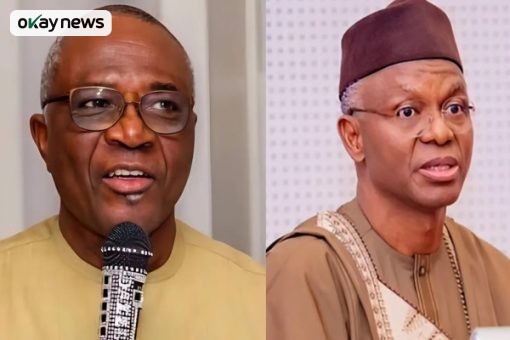
Nigeria’s Special Adviser on Information and Strategy to President Bola Ahmed Tinubu, Bayo Onanuga, has called for law enforcement agencies to investigate comments by Nasir Ahmad El-Rufai, a former governor of Kaduna State in north-western Nigeria, after El-Rufai suggested he had access to wire-tapped phone conversations involving Nigeria’s National Security Adviser, Nuhu Ribadu.
Onanuga made the call in a message posted on X, the social media platform formerly known as Twitter, on Friday, February 13, 2026, after El-Rufai spoke during an interview on Arise Television (ARISE TV) Prime Time. Okay News reports that the dispute has intensified public debate about the use of security agencies, the limits of state power, and the legality of surveillance in Nigeria, Africa’s most populous country.
During the interview, El-Rufai alleged that Ribadu, Nigeria’s top security coordinator as National Security Adviser (NSA), ordered his arrest after what El-Rufai described as a failed attempt to detain him at Nnamdi Azikiwe International Airport in Abuja, Nigeria’s federal capital city, on Thursday, February 12, 2026.
El-Rufai claimed that the Independent Corrupt Practices and Other Related Offences Commission (ICPC), a Nigerian government anti-corruption agency, used the Department of State Services (DSS), Nigeria’s domestic intelligence and security service, to carry out the operation.
“We found out that it was the ICPC that procured the DSS to abduct me and then hand me over to them,” El-Rufai said.
“And this is a modus operandi of the ICPC that increasingly has become a personal tool of Nuhu Ribadu. Nuhu made the call and made the order that I must be in custody yesterday.”
When asked how he believed Ribadu authorised the alleged action, El-Rufai replied: “He made the call because we listened to their calls. The government thinks that they are the only ones that listen to calls. But we also have our ways.”
Onanuga argued that this statement went beyond a political allegation and amounted to an admission of illegal wire-tapping, which he said should attract the attention of investigators.
“El-Rufai confesses to wire-tapping Nigeria’s NSA on TV,” Onanuga wrote.
“Does it mean that he and his collaborators have wire-tapping facilities? This should be thoroughly investigated and punishment meted out. El-Rufai is not too big to face the wrath of the law.”
The comments have drawn wider reactions, including from Deji Adeyanju, a Nigerian human rights lawyer and political activist. Adeyanju described the reported attempt to arrest El-Rufai as “karma” catching up him, while also saying he was not persuaded that there was a clear and concrete plan to arrest the former Kaduna governor.
Adeyanju said Nigeria’s laws allow arrests through established procedures, including a court-issued warrant or other legally recognised grounds, and he maintained that if authorities truly intended to detain El-Rufai, there were formal legal mechanisms available to do so.