Former Governor of Ekiti State in southwestern Nigeria, Ayodele Fayose, has asserted that the Peoples Democratic Party, one of Nigeria’s major political parties, has lost its status as the country’s leading opposition force due to deep-rooted internal divisions and unresolved leadership conflicts.
Fayose made this assertion while speaking during a televised interview on Arise News, a Lagos-based Nigerian television station known for political analysis and current affairs programming. His remarks focused on the evolving dynamics within Nigeria’s opposition politics ahead of the 2027 general elections, a nationwide poll that will determine the country’s next set of federal and state leaders.
According to Fayose, the crisis confronting the Peoples Democratic Party is entirely self-inflicted and not caused by external political pressure from the ruling party, the All Progressives Congress, which currently controls Nigeria’s federal government under President Bola Ahmed Tinubu, Nigeria’s Head of State and Government.
Okay News reports that Fayose rejected claims that the ruling party or President Tinubu, a former Governor of Lagos State and a central figure in Nigerian politics, was responsible for the opposition party’s struggles.
“You must be very honest. When you are weak, tendencies are there for you to fall to the right of the stronger side,” Fayose said during the interview.
He further dismissed suggestions that President Tinubu, popularly referred to as Asiwaju, was behind the party’s decline, insisting that internal failures should not be blamed on political rivals.
“The challenges in the Peoples Democratic Party, it is not the fault of Asiwaju, the president,” Fayose said.
“No. The failure in my home – God forbid – is not the fault of my neighbour,” he added.
Describing the state of the party, Fayose said the Peoples Democratic Party is deeply divided and unable to function as a cohesive opposition platform capable of challenging the ruling party.
“The issues are very clear. The Peoples Democratic Party is a house that is divided against itself,” he stated.
Shifting attention to Nigeria’s wider opposition landscape, Fayose argued that the country typically operates within a two-party dominance structure at any given time, but said that emerging political movements are reshaping that tradition.
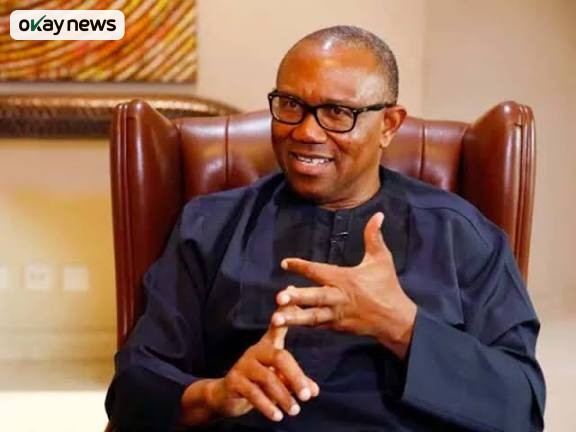
He specifically highlighted the African Democratic Congress, a Nigerian political party that has recently gained renewed attention following the reported defection of Peter Obi, a former Governor of Anambra State in southeastern Nigeria and the Labour Party’s presidential candidate in the 2023 general election.
“Are we saying the African Democratic Congress is not dominant? Recently, Obi moved there. And I have said it. Obi is the only life in the African Democratic Congress,” Fayose said.
When it was suggested by journalist Reuben Abati that other prominent figures, including former Vice President of Nigeria, Atiku Abubakar, were also associated with the platform, Fayose downplayed their political relevance.
“I am not saying they are not human beings, I am saying they are largely spent forces,” he responded.
Fayose emphasized Peter Obi’s political influence, arguing that Obi’s personal credibility and voter appeal alone have elevated the African Democratic Congress in national relevance.
“Let Obi not go to the African Democratic Congress. Let Obi go to another party. Let us say Obi is in Accord,” he said.
“Obi is the only traction. Obi is the only meaning, Obi is the only factor, Obi is the only person in the African Democratic Congress that matters.”
He concluded by suggesting that the party’s fortunes are now directly tied to Obi’s political journey.
“And if Obi had not gone to the African Democratic Congress, I am not saying Obi will win this election. I am not saying Obi will not win this election,” Fayose added.
“But I am telling you, even if you do not feed Obi, if the African Democratic Congress fails to feed Obi, their case will be worse than their coming together.”